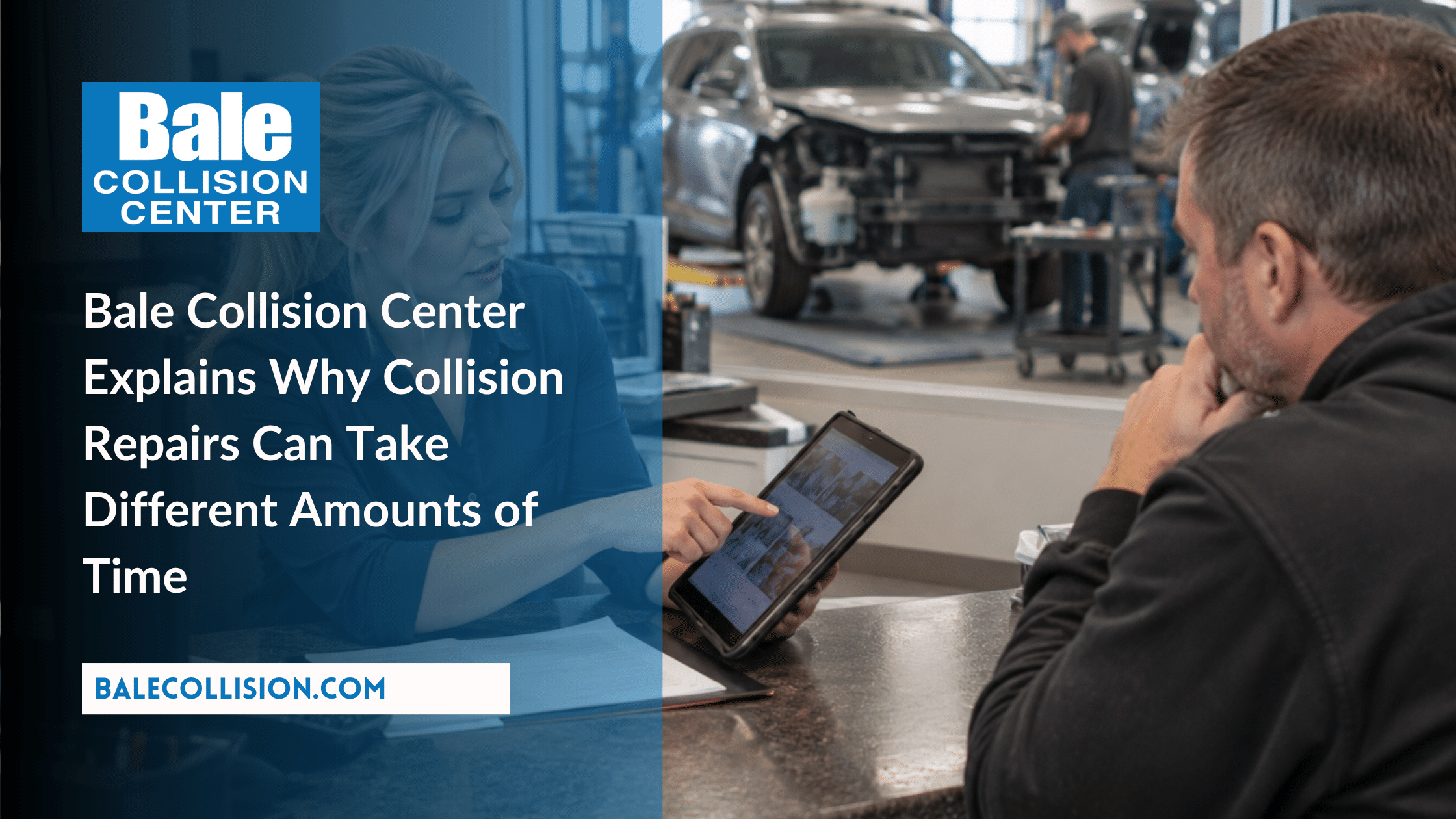
Bale Collision Center Explains Why Collision Repairs Can Take Different Amounts of Time
Little Rock, AR - September 17, 2026 - PRESSADVANTAGE - Bale Collision Center has published consumer guidance

Press Release Disclaimer: This is a press release distributed through the XPR Media network. It has not been independently verified by our newsroom.

Little Rock, AR – September 17, 2026 – PRESSADVANTAGE –
Bale Collision Center has published consumer guidance explaining why collision repair timelines can differ substantially even when two vehicles appear to have similar accident damage. The September resource organizes repair timing around four stages: damage discovery and repair planning, parts requirements, repair and refinishing operations, and vehicle-specific procedures.
The guidance expands on Bale Collision Center’s collision repair information by addressing why an initial completion estimate may change as technicians develop a more complete understanding of the repairs required for an individual vehicle.
Visible damage provides a starting point, but it does not necessarily describe every operation involved in the repair. A bumper, fender, door, lamp, or other exterior component can limit access to mounting points, adjoining areas, wiring, or components positioned behind it.
The first stage affecting timing is therefore damage discovery and repair planning. An initial inspection documents accessible collision damage. When the repair process requires disassembly, additional areas can become available for evaluation. Accident-related conditions identified at that stage can be incorporated into the developed repair plan.
This distinction is important for understanding repair timelines. An early estimate is based on information available at that point, while the developed repair plan can account for conditions identified after appropriate access has been created.
Parts requirements form the second stage. Collision repairs can involve body panels, lamps, brackets, trim, glass, electronic components, fasteners, and other vehicle-specific parts. What is required depends on the documented damage and whether individual components can be repaired or require replacement under the applicable procedure.
Vehicle configuration can also affect parts identification. Model year, trim level, installed equipment, and other specifications can determine which component corresponds with the vehicle being repaired. Parts planning therefore involves more than identifying the general type of component that appears damaged.
The third stage covers the actual repair and refinishing sequence. Collision repair can involve several operations that must occur in a particular order rather than simultaneously.
Body and structural work, when required, can precede the installation or refinishing of other components. Parts removed for access may remain off the vehicle until underlying work is completed. Repaired or replacement exterior components can then move through the appropriate preparation and refinishing operations.
Bale Collision Center’s auto body repair information provides additional context about the body repair operations that can be part of this sequence.
Refinishing itself can involve multiple steps, including surface preparation, primer, color application, clear coating, curing, finishing, and inspection as applicable to the repair. These operations contribute to the overall timeline because they form part of a defined repair sequence rather than a single painting step.
The fourth stage involves vehicle-specific procedures. Modern vehicles can use different combinations of steel, high-strength steel, aluminum, plastics, and other materials. They can also contain cameras, sensors, electronic modules, and other technology in collision-prone areas.
Technicians can identify the affected components and review applicable manufacturer repair information when developing the repair plan. Depending on the vehicle and repair, that information may address component repairability, replacement requirements, joining methods, corrosion protection, diagnostic operations, or calibration procedures.
Diagnostic scanning or calibration is not required simply because a vehicle contains advanced technology. Whether those operations apply depends on the vehicle’s equipment, collision damage, components affected by the repair, and applicable procedures.
These four stages give consumers a more useful framework for understanding repair duration than assigning a standard number of days to a particular type of accident. A repair involving one visibly damaged panel can still require several supporting operations, while another vehicle with broader cosmetic damage may follow a different repair sequence.
Insurance claim documentation can add another step when additional accident-related damage is identified during repair planning. Updated photographs, parts information, or revisions to the repair plan may need to be communicated as part of the claim process. The requirements and timing vary with the individual claim.
The September guidance also distinguishes repair duration from repair quality. A shorter repair is not automatically better, and a longer repair does not by itself indicate a problem. The relevant consideration is whether the timeline reflects the documented damage and the operations required for the specific vehicle.
The new resource therefore gives consumers four points for following repair progress: whether repair planning is complete, whether required parts have been identified, which repair or refinishing stage the vehicle has reached, and whether vehicle-specific procedures remain before final review.
This framework is intended to make changing completion estimates easier to understand. A timeline established early in the process may be revised when additional documented damage, parts requirements, or vehicle-specific operations change the amount or sequence of work required.
Information about Bale Collision Center is also available through its Chenal location resource.
The central point of the September guidance is that collision repair time follows the work required by the individual vehicle rather than a predetermined schedule based solely on visible damage. Repair planning, parts, repair and refinishing operations, and vehicle-specific procedures collectively establish the sequence that must be completed before the vehicle reaches final review.
Bale Collision Center has served Little Rock since 1952 and provides collision repair and auto body repair services for drivers in Little Rock and surrounding Arkansas communities. Its services include collision and auto body repair, paintless dent repair, glass replacement, ADAS services, and automotive refinishing. The company operates locations serving the Chenal and Downtown Little Rock areas.
###
For more information about Bale Collision Center, contact the company here:
Bale Collision Center (Chenal)
Jason Spiller
(501) 221-7181
jspiller@baleautomotive.com
13101 Chenal Pkwy, Little Rock, AR 72211, United States