Time theft report: What 800-plus hourly workers admit about life on the clock
OnTheClock reports over 800 hourly workers admit to time theft, with 25% engaging in buddy punching and 43%

Press Release Disclaimer: This is a press release distributed through the XPR Media network. It has not been independently verified by our newsroom.



DG FotoStock // Shutterstock
Time theft report: What 800-plus hourly workers admit about life on the clock
Most employers know their hourly workers aren’t heads-down every minute of their shift. However, time-card discrepancies and adjusted hours have a way of quietly adding up. An OnTheClock survey of more than 830 hourly workers puts numbers on just how common these habits actually are.
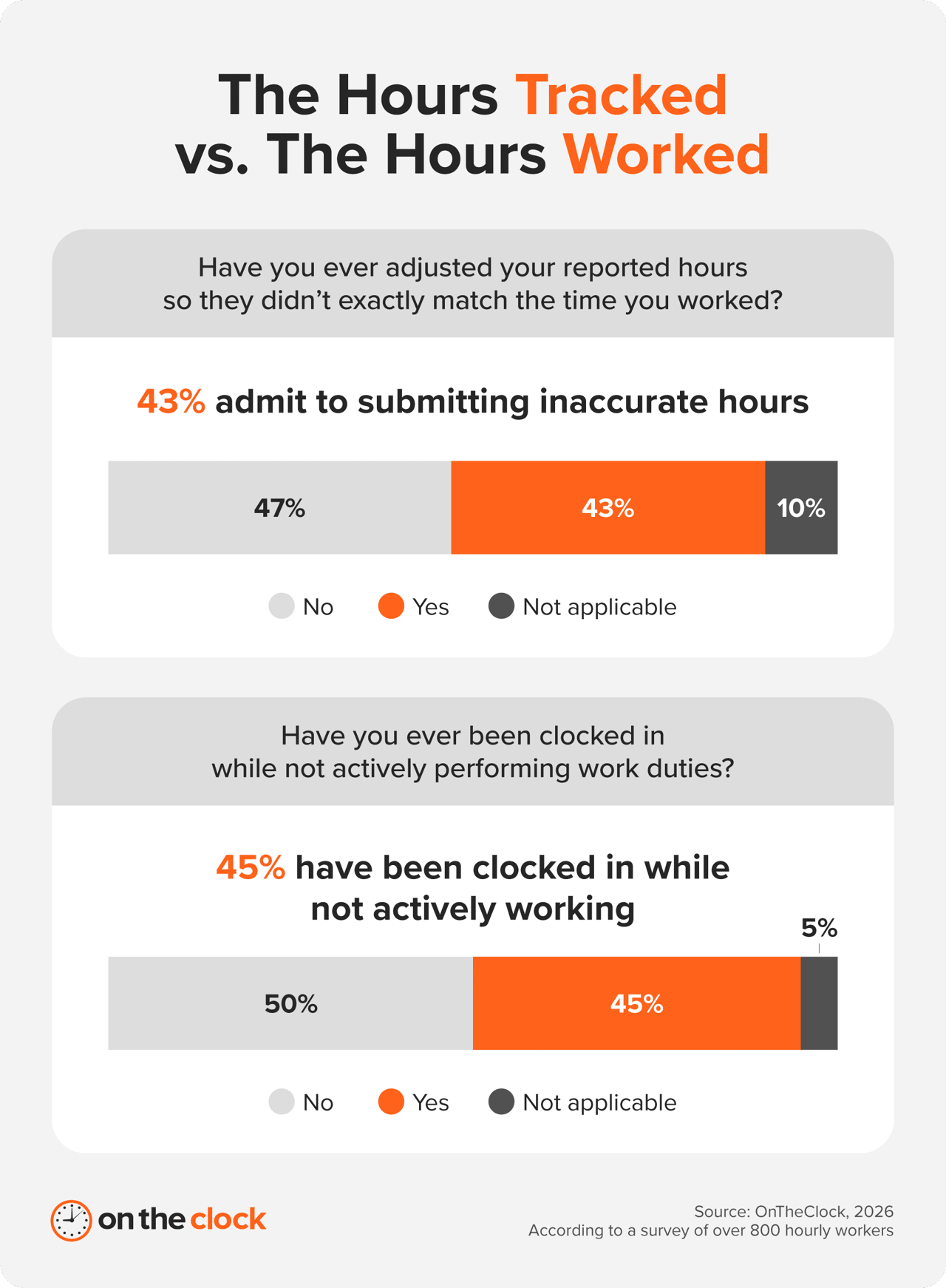
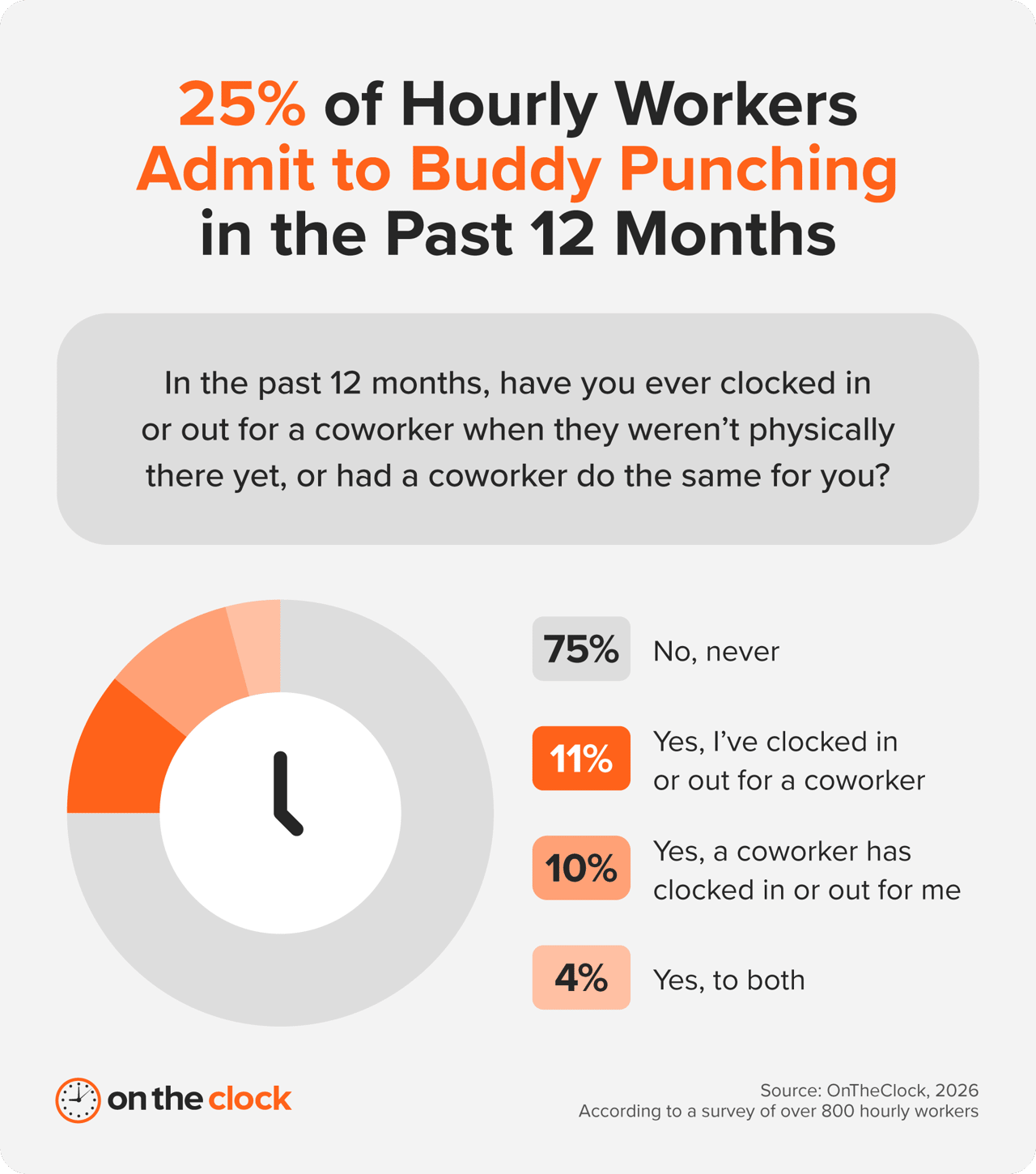
The survey found that 1 in 4 have clocked in or out for a co-worker or had a co-worker clock in or out for them, also known as buddy punching. Nearly half (43%) have submitted time sheets that didn’t match the hours they actually worked.
The survey results show how common it is for time sheets to not accurately reflect actual hours worked, and how teams can get back on track.
Key Takeaways
- In the last 12 months, 1 in 4 hourly U.S. workers say they clocked in or out for a co-worker who wasn’t at work yet, or had someone clock in for them.
- 43% of hourly workers have adjusted their reported hours, yet 79% believe their employer/manager reviews time cards closely.
- 55% of hourly workers handle personal texts, calls, or emails on the clock, and 83% spend at least some of their time at work on personal matters.
- 66% of hourly workers say more monitoring would not change how they spend time at work, so stricter oversight may not produce the results employers are hoping for.
43% of Workers Have Misreported Their Hours, and It Happens Whether Managers Check Closely or Not
Time-tracking records that look accurate on paper are not always an accurate reflection of what happened on the clock. Forty-three percent of hourly workers have adjusted their reported hours to misrepresent how many hours they worked, and 17% say they do so on a weekly or daily basis. Separately, 45% have clocked in while not actively working, whether that means clocking in before a shift starts, not clocking out for lunch, or forgetting to clock out after finishing work.
The cost adds up quickly. According to U.S. Bureau of Labor Statistics (BLS) data, as of July 2026, the average hourly wage for private sector production and nonsupervisory workers is $32.40. If one worker overreports by an hour per week, that comes to roughly $1,684 in excess payroll over the course of a year. For a 10-person hourly team, that figure climbs past $16,800 annually, before accounting for payroll taxes.
OnTheClock
The majority (79%) of workers believe their managers review their time cards very or extremely thoroughly before approving payroll, but oversight doesn’t necessarily lead to more accurate records. Among workers who adjust their hours on a weekly or daily basis, 92% still believe their manager checks their time cards carefully. That only drops to 81% among those who do it a few times a month.
Managers may want to consider that, if workers adjust their time cards despite oversight, tightening oversight may not be the solution to inaccurate reporting of work hours.
71% of Employees Know Buddy Punching Is Against Company Rules, but Some Are Doing it Anyway
Compared with other forms of “time theft,” buddy punching can be hard for employers to catch. Buddy punching is when one employee clocks in or out for a co-worker who isn’t at work yet or has already left.
One in 4 (25%) hourly employees in the survey has engaged in buddy punching over the past 12 months. This may be against their workplace policy. Seven out of 10 (71%) workers say their employers already have a clear policy against buddy punching.
OnTheClock
Still, 31% of workers believe buddy punching is either no big deal or acceptable in certain situations. These workers are also significantly more likely to have inaccurate time records.
Buddy punching rarely happens in isolation. Seventy-one percent of workers who are comfortable with buddy punching have adjusted their reported hours to not match the time they actually worked, compared with 43% of all workers.
Clocking in for a co-worker can feel like a small favor, but the data suggests it rarely stops there. Workers who are comfortable with buddy punching are significantly more likely to have adjusted their own reported hours at some point, too. What starts as covering for a teammate often shows up elsewhere on their time cards.
Gen Z Buddy Punches More Than 1.5 Times the Overall Rate, and Half Don’t See Anything Wrong With it
Gen Z workers (ages 18-29) are more than 1.5 times as likely to buddy punch as workers overall (41% vs. 25%). And 51% of Gen Z workers say it’s either no big deal or fine in certain situations, compared to 31% of all workers surveyed.
Gen Z workers are relatively new to the workplace. The higher rate may be due in part to many not knowing that buddy punching could be considered time theft. Still, as Gen Z becomes a larger share of the hourly workforce, employers who rely on the honor system for timekeeping should take note. Whether the higher rate reflects attitude or inexperience, the payroll effects are the same.
What’s Actually Happening During Paid Hours
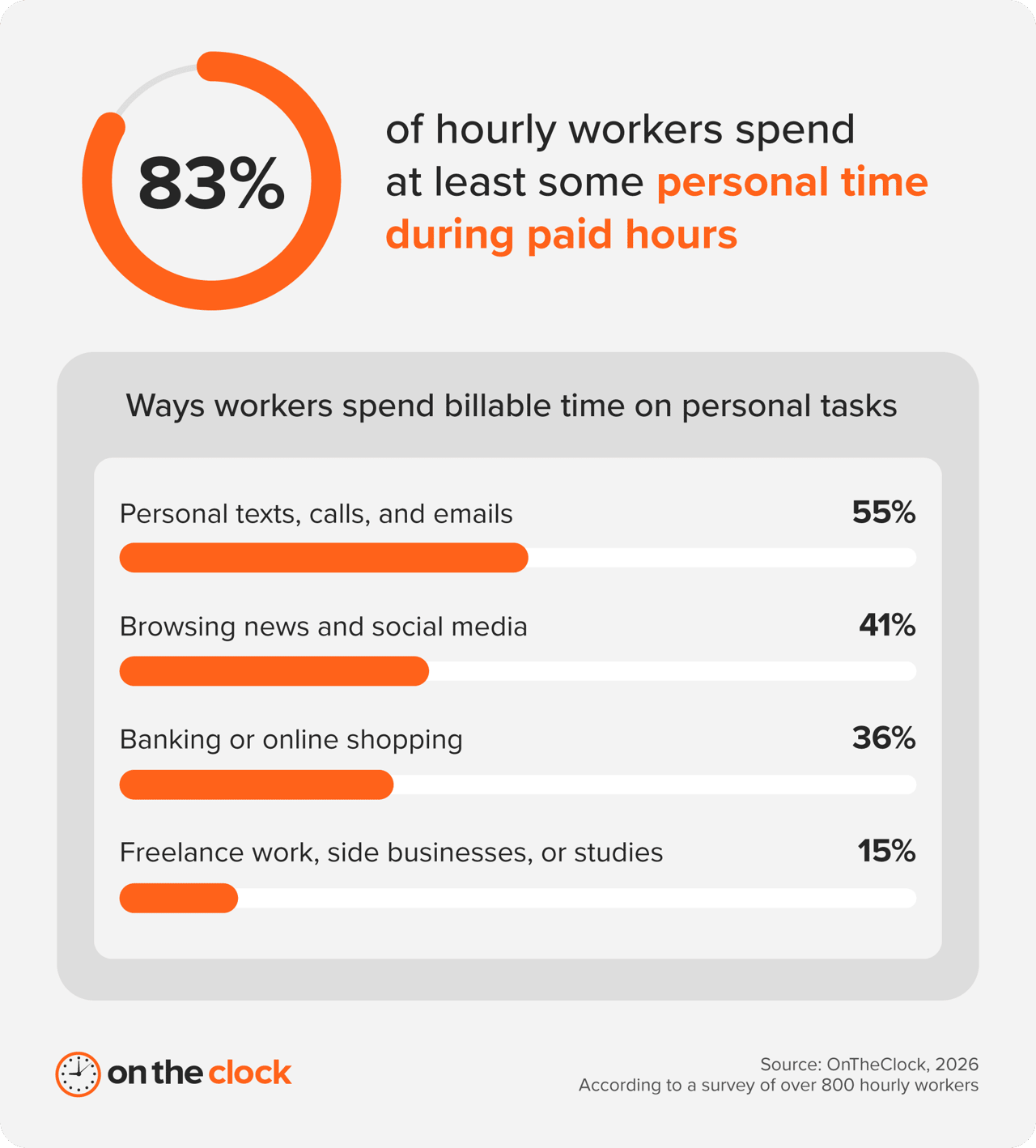
Workers often spend billable time on personal tasks. Most hourly workers spend at least some personal time during paid hours (83%), and nearly half (48%) spend 30 minutes or more per day doing so.
Workplace distractions come in many forms, and the data shows they are widespread.
OnTheClock
- Personal texts, calls, and emails (55%)
- Browsing news and social media (41%)
- Personal tasks, like banking or online shopping (36%)
- Managing outside freelance work, side businesses, or studies (15%)
Many workers who spend paid time on at least one personal task also submit inaccurate hours. Among that group, 48% adjusted their time sheets at some point, compared to 14% of workers who reported no personal tasks.
Similarly, 50% of workers who lost time handling personal tasks have also clocked in while not actively working, compared to 18% who haven’t spent time on personal tasks. Not every worker who handles personal tasks during paid hours will also have time-card discrepancies, but the data shows the two are far more likely to occur together than separately.
Some of what workers report is fairly expected. A quick personal call or a few minutes of browsing is something most employers account for. But other habits on the list, like stepping away for errands or catching up on a show, are the kind that many workplace policies explicitly prohibit.
For employers with noncompete agreements in place, it may also be worth having a clear conversation with hourly staff about what outside work is and isn’t permitted during paid hours.
The Honor System Isn’t Working: 4 Tips For Employers
Two-thirds of hourly workers say more monitoring, such as GPS tracking of remote workers or activity screenshots, wouldn’t change their behavior at all. That points to something most employers already sense but may not know how to act on: Employee behavior is difficult to control through oversight alone.
The data in this report consistently shows that inaccurate records remain common even in workplaces where timekeeping policies exist and managers are perceived to pay close attention.
Here are a few practical steps that can help employers ensure their team’s time records are accurate:
- Audit a random sample of time cards monthly rather than relying on routine approval. Spot-checking creates a more consistent sense of accountability, since workers are less likely to know in advance which submissions will be reviewed closely.
- Make sure newer hourly workers understand not just the rules, but why they matter. Awareness of a policy does not always translate into respect for it, and the data suggests that this gap is more common earlier in someone’s working life.
- Consider whether your current tracking method gives you visibility into when employees are actually working. When employees self-report their hours or fill in a time sheet at the end of a shift, there is more room for discrepancies between what is recorded and what actually happened. Tools that require individual employee logins, use GPS geofencing to verify location, or apply IP restrictions to clock-ins can make it significantly harder for hours to be recorded inaccurately in the first place.
- Back your timekeeping policies with training and clear expectations around accountability. The data shows that most workers are already aware of their employer’s timekeeping rules. Pairing that awareness with regular training on why accurate timekeeping matters, and making clear what happens when a policy is violated, reinforces that the rules carry real weight.
Methodology
This survey was conducted online by Centiment on behalf of OnTheClock. The total sample includes 831 employed U.S.-based adults aged 18 years and older who are currently employed full- or part-time by an employer as hourly workers. Each respondent was screened to ensure they are required to track, log, or submit their work hours using time cards, time sheets, clock-in/out systems, or automatic time-tracking systems.
Fieldwork was undertaken from July 1 to July 9, 2026. Data is unweighted, and the margin of error is approximately ±3 % for the overall sample at the 95% confidence level.
This story was produced by OnTheClock and reviewed and distributed by Stacker.