Global Fixed Base Operators (FBO) Market Set to Climb from US$ 11.01 Billion in 2024 to US$ 17.70 Billion by 2035
Fixed base operators market to grow steadily through 2035 on rising private aviation demand, technology adoption &

Press Release Disclaimer: This is a press release distributed through the XPR Media network. It has not been independently verified by our newsroom.
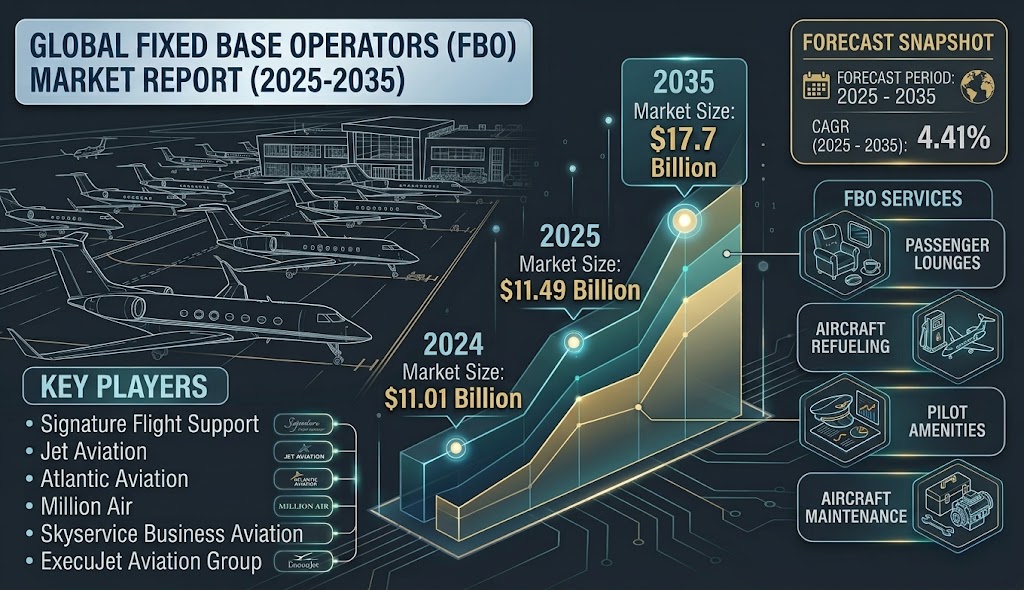

Fixed base operators market to grow steadily through 2035 on rising private aviation demand, technology adoption & sustainability-led service expansion globally
NEW YORK, NY, UNITED STATES, August 27, 2026 /EINPresswire.com/ — The global Fixed Base Operators (FBO) Market is on a steady upward trajectory, with its valuation pegged at approximately USD 11.01 billion in 2024 and expected to edge up to nearly USD 11.49 billion in 2025. Looking further out, industry estimates suggest the market could approach USD 17.70 billion by 2035, translating into a compound annual growth rate (CAGR) of close to 4.41% across the 2025-2035 forecast window. This upward curve reflects a broader transformation taking place across airports worldwide, where private aviation, business jet travel, and cargo operations are converging to reshape how ground-service providers operate and compete.
FBOs — the ground-service companies stationed at airports that handle fueling, hangar space, maintenance, passenger amenities, and a range of ancillary aviation services — sit at the intersection of several converging trends: a swelling population of high-net-worth travelers, corporations prioritizing time-efficient travel, and airports investing heavily in modernized terminal infrastructure. Together, these forces are pushing FBOs to rethink their service portfolios, invest in technology, and differentiate themselves through customer experience.
A Market Shaped by Private Aviation and Infrastructure Investment:
Industry watchers point to several forces underpinning this expansion. Chief among them is the continued rise of private and business aviation, as affluent individuals and corporate travelers increasingly favor the flexibility, privacy, and time savings that private flying affords over commercial alternatives. This shift is prompting FBOs to expand their footprints and upgrade amenities to match the expectations of a more discerning clientele.
Request for Free Sample of Report: https://www.marketresearchfuture.com/sample_request/26079
Airport infrastructure development is another significant tailwind. Numerous regions are channeling capital into new terminals, expanded aprons, and modernized ground facilities to accommodate a growing volume of private and charter flights. As airports scale up their capacity, FBOs located on-site typically see a corresponding uptick in demand for their services, from fueling and hangar storage to passenger handling and ground transportation.
Technology is also playing an increasingly central role. Operators are integrating digital tools such as mobile applications for service booking, automated fuel-management systems, and streamlined check-in processes, all aimed at improving turnaround times and elevating the customer experience. This digital push is expected to become a key differentiator among competing FBO networks in the years ahead.
Sustainability has likewise moved to the forefront of strategic planning. Many FBOs are incorporating sustainable aviation fuel options, energy-efficient ground support equipment, and waste-reduction practices into daily operations, both to meet tightening regulatory expectations and to appeal to an increasingly environmentally conscious client base. Regulatory shifts favoring private aviation — including incentives and simplified permitting in several jurisdictions — are further encouraging market participation and expansion.
Segment Insights:
The FBO market can be examined across several distinct lenses, each revealing different growth dynamics.
By Ownership Model, the market is generally divided into company-owned, airport-owned, and independently-owned operations. Company-owned FBOs currently command the largest share of the market, benefiting from established brand recognition, deeper financial resources, and the ability to invest heavily in infrastructure and service breadth. Independently-owned FBOs, meanwhile, are emerging as the fastest-growing segment, carving out a niche by offering specialized, highly personalized services that appeal to particular customer segments seeking flexibility outside larger networks.
By Services Offered, the market spans aircraft maintenance, fueling, hangar rental, cabin cleaning, ground transportation, and passenger handling. Fueling remains the largest single service category, given its status as a non-negotiable requirement for virtually every aircraft that lands at an FBO-serviced facility. Aircraft maintenance, however, is emerging as the fastest-growing service line, propelled by tightening safety standards, a rising number of private and commercial flights, and operators’ growing focus on extending aircraft lifespan through more comprehensive upkeep programs.
By Customer Type, the market includes private aircraft owners, commercial airlines, government entities, cargo operators, and charter operators. Private aircraft owners represent the largest customer base, drawn to the exclusivity, privacy, and tailored service that FBOs provide. Charter operators, by contrast, are the fastest-growing customer segment, buoyed by the rising popularity of on-demand air travel, which offers many of the benefits of private ownership at a comparatively lower cost — a proposition that continues to gain traction among leisure and business travelers alike.
By Aircraft Category, the market divides into business jets, commercial airliners, private aircraft, helicopters, and cargo aircraft. Business jets hold the largest share, reflecting their central role in corporate travel and high-net-worth mobility, and their frequent reliance on FBOs offering concierge-level service and dedicated maintenance support. Commercial airliners and cargo aircraft are also notable contributors; cargo aircraft in particular are gaining momentum as e-commerce growth drives airlines and logistics firms to invest in dedicated cargo-handling capabilities at FBO facilities.
By Size, FBOs are categorized as small (under 50,000 square feet), medium (50,000 to 250,000 square feet), and large (over 250,000 square feet) facilities. Large FBOs dominate the market, leveraging economies of scale, extensive service portfolios, and strong relationships with airlines and airport authorities. Small FBOs, however, are growing at the fastest pace, thanks to their ability to deliver personalized, community-oriented service and to respond nimbly to shifting demand in emerging and niche markets, including the rise of fractional aircraft ownership.
Regional Outlook:
Geographically, the FBO market spans North America, Europe, South America, Asia-Pacific, and the Middle East and Africa. North America continues to anchor the global market, underpinned by a mature private aviation ecosystem, a dense network of general aviation airports, and sustained demand from business and leisure flyers alike. Europe follows as a well-established market, supported by a long history of business aviation infrastructure and cross-border corporate travel.
Asia-Pacific, meanwhile, is widely regarded as the fastest-growing region, fueled by expanding airport infrastructure investment, a rapidly growing base of high-net-worth individuals, and increasing corporate demand for efficient regional travel options. The Middle East and Africa, along with South America, are also seeing incremental gains as governments and private investors expand aviation infrastructure to support tourism, trade, and business connectivity.
Competitive Landscape:
The FBO market remains moderately consolidated, with a handful of established global networks competing alongside a long tail of regional and independent operators. Prominent names shaping the competitive landscape include Signature Flight Support, Jet Aviation, Atlantic Aviation, Million Air, Skyservice Business Aviation, ExecuJet Aviation Group, Duncan Aviation, BBA Aviation, and MJet.
Signature Flight Support operates one of the most expansive FBO networks globally and has invested in digital tools, including mobile applications that let clients track aircraft status, arrange services, and manage bookings remotely — part of a broader push toward more connected, tech-enabled customer experiences. Jet Aviation and Atlantic Aviation similarly maintain broad international footprints, offering fueling, maintenance, and ground-handling services across major business aviation hubs. Million Air and Skyservice Business Aviation have built reputations around premium, high-touch service models tailored to private and corporate clientele, while ExecuJet Aviation Group, Duncan Aviation, BBA Aviation, and MJet round out a competitive field that spans North America, Europe, and beyond.
Across the board, leading players are prioritizing network expansion, deeper technology integration, and strategic partnerships as they compete for market share. Value-added offerings — from advanced maintenance packages to enhanced ground-handling and flight-planning support — are increasingly viewed as key differentiators. The competitive landscape has also seen consolidation activity, including acquisitions that have brought smaller regional operators under larger corporate umbrellas, alongside the launch of new facilities by operators seeking to strengthen their presence at high-traffic airports.
Growth Opportunities Ahead:
Several opportunities stand out as the market moves toward 2035. Expanding cargo-handling capabilities at regional and secondary airports represents a meaningful growth avenue, particularly as e-commerce volumes continue to climb and logistics providers seek dedicated ground infrastructure. Advanced fuel-management systems offer another avenue for efficiency gains, helping operators reduce turnaround times while managing costs more effectively.
The development of premium passenger lounges and exclusive amenities is also emerging as a differentiator, as FBOs compete to attract discerning private and business travelers who prioritize comfort and convenience. Meanwhile, continued investment in sustainability — from sustainable aviation fuel adoption to energy-efficient ground equipment — is expected to remain a defining theme, as operators align their offerings with evolving environmental expectations from both regulators and clients.
Outlook:
Taken together, these dynamics point to a market that is expected to remain resilient and adaptive through the coming decade. With private aviation demand showing few signs of slowing, airport infrastructure investment continuing across multiple regions, and technology and sustainability initiatives reshaping day-to-day operations, the Fixed Base Operators (FBO) Market appears well positioned to sustain its growth trajectory toward an estimated USD 17.70 billion valuation by 2035.
Stakeholders across the aviation value chain — from airport authorities and aircraft owners to service providers and investors — are likely to keep a close watch on how ownership models, service portfolios, and regional dynamics evolve as competition intensifies and customer expectations continue to rise.
Browse More Reports:
Business Aircraft Market
https://www.marketresearchfuture.com/reports/business-aircraft-market-3952
Airport Services Market
https://www.marketresearchfuture.com/reports/airport-services-market-8395
Airport Runway Foreign Object Debris Detection System Market
https://www.marketresearchfuture.com/reports/airport-runway-foreign-object-debris-detection-system-market-33844
Market Research Future
Market Research Future
+1 855-661-4441
sales@marketresearchfuture.com
Legal Disclaimer:
EIN Presswire provides this news content “as is” without warranty of any kind. We do not accept any responsibility or liability
for the accuracy, content, images, videos, licenses, completeness, legality, or reliability of the information contained in this
article. If you have any complaints or copyright issues related to this article, kindly contact the author above.

Media gallery