Radiopharmaceuticals Market to reach USD 18.52 Billion by 2035 at 9.12% CAGR
Radiopharmaceuticals Market to Surge from USD 7.74 Billion in 2025 to USD 18.52 Billion by 2035 --- Powered by Targeted

Press Release Disclaimer: This is a press release distributed through the XPR Media network. It has not been independently verified by our newsroom.
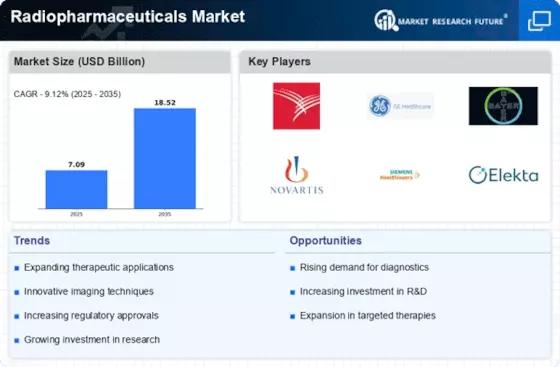

Radiopharmaceuticals Market to Surge from USD 7.74 Billion in 2025 to USD 18.52 Billion by 2035 — Powered by Targeted Alpha Therapies, Theranostics Innovation
NY, CA, UNITED STATES, August 24, 2026 /EINPresswire.com/ — As per Market Research Future, the global Radiopharmaceuticals Market size was valued at USD 7.09 Billion in 2024 and is projected to grow from USD 7.74 Billion in 2025 to USD 18.52 Billion by 2035, exhibiting a CAGR of 9.12% during the forecast period 2025–2035.
The 9.12% CAGR is being supported by three converging forces: increasing global incidence of cancer and cardiovascular diseases, rapid advancements in theranostics and targeted radioligand therapies, and continuous expansion of nuclear medicine infrastructure including PET and SPECT imaging facilities. Radiopharmaceuticals offer precise target-binding capabilities, enabling early disease detection and localized radiation delivery with minimal damage to healthy surrounding tissue, thereby strengthening their clinical utility across diagnostic and therapeutic settings.
Healthcare providers are increasingly adopting advanced radiopharmaceutical agents across hospitals, diagnostic imaging centers, and research institutions. Growing clinical reliance on targeted radionuclide therapies, such as PSMA-targeted radioligands and peptide receptor radionuclide therapy (PRRT), is significantly broadening the addressable market. North America remains the dominant regional market, while Asia-Pacific is established as the fastest-growing region driven by substantial nuclear medicine investments and expanding patient access.
Request A Free Sample: https://www.marketresearchfuture.com/sample_request/1650
Key Market Trends & Growth Drivers
Rising Global Burden of Oncology & Cardiovascular Diseases
Oncology remains the primary therapeutic driver for radiopharmaceuticals. According to the World Health Organization (WHO), cancer is responsible for nearly 10 million deaths annually, creating sustained clinical demand for both early diagnostic evaluation and potent localized therapies. Coupled with an escalating global burden of cardiovascular conditions and neurodegenerative disorders, nuclear medicine techniques (specifically PET/CT and SPECT) have become indispensable for non-invasive disease staging, monitoring, and therapeutic selection.
The structural shift toward precision medicine is encouraging clinical institutions to integrate nuclear imaging earlier in treatment pathways. As specialized clinics and cancer centers aim to improve diagnostic accuracy and patient outcomes, demand for stable, high-affinity diagnostic tracers and targeted radioisotopes is projected to accelerate.
Technological Advancements & Theranostics Paradigm Shift
Theranostics—the integration of diagnostic imaging and targeted radionuclide therapy using identical or structurally similar molecular vectors—represents a groundbreaking trend in precision healthcare. By utilizing diagnostic isotopes (such as Gallium-68 or Fluorine-18) to visualize target expression prior to administering therapeutic radioisotopes (such as Lutetium-177 or Actinium-225), clinicians can select patients most likely to respond to therapy.
Innovations in isotope production technologies, including high-yield medical cyclotrons, automated synthesis modules, and generator platforms (e.g., Germanium-68/Gallium-68 generators), are expanding production throughput and logistical reliability. Furthermore, biopharma manufacturers are focusing heavily on Next-Gen Targeted Alpha Therapies (TAT) due to their high linear energy transfer and localized cell-killing capability.
Expanding Applications & Favorable Regulatory Incentives
Beyond oncology, radiopharmaceuticals are making significant inroads into neurology for Alzheimer’s disease diagnosis (using amyloid and tau PET tracers) and cardiology for myocardial perfusion imaging. Streamlined regulatory pathways, CMS reimbursement updates in North America, and supportive policies from the European Medicines Agency (EMA) are improving patient access to newly commercialized radiopharmaceutical drugs.
Strategic supply chain investments, centralized radiopharmacy networks, and joint ventures between isotope producers and global pharmaceutical companies are resolving historical radioisotope half-life logistics, allowing broader commercial distribution across regional healthcare centers.
Ask for Customization: https://www.marketresearchfuture.com/ask_for_customize/1650
Market Segment Insights
BY APPLICATION
Diagnosis: Dominant application segment commanding approximately 64% market share in 2024. Demand is strongly driven by the widespread utilization of PET and SPECT procedures for early cancer staging, cardiac function evaluation, and neurodegenerative disease assessment.
Therapy: Rapidly expanding application segment projected to achieve significant growth through 2035. Growth is fueled by clinical adoption of targeted radioligand therapies, peptide receptor radionuclide therapy (PRRT), and emerging targeted alpha therapies for prostate cancer, neuroendocrine tumors, and bone metastases.
Research: Essential application supporting novel drug discovery, translational oncology studies, and biomarker development in academic institutions and pharmaceutical research labs.
BY TYPES
Diagnostic Radiopharmaceuticals: Leading category accounting for the majority of market revenue, supported by routine PET/CT scans, Technetium-99m labeled agents, and Fluorine-18 radiotracers across global clinical networks.
Therapeutic Radiopharmaceuticals: High-growth segment driven by novel radioimmunotherapies, Beta-emitters (Lutetium-177, Yttrium-90), and Alpha-emitters (Radium-223, Actinium-225).
BY RADIOPHARMACEUTICAL CLASS
Radioisotopes: Core elemental radionuclides including Technetium-99m, Fluorine-18, Iodine-131, Lutetium-177, and Gallium-68 serving as essential foundation materials for imaging and therapy.
Radiolabeled Compounds: Rapidly growing segment comprising specialized complex molecules, monoclonal antibodies, and peptides engineered for precise target-receptor binding in molecular imaging and targeted drug delivery.
Radiopharmaceutical Generators: Crucial operational hardware including Mo-99/Tc-99m and Ge-68/Ga-68 generators that provide reliable on-site radiopharmaceutical production in clinical settings.
BY END USE
Hospitals: Dominant end-use segment. Hospitals represent the primary site for inpatient nuclear medicine treatment, complex oncological procedures, and multi-modal imaging installations.
Diagnostic Imaging Centers: Fast-growing end-user category as outpatient specialized imaging centers expand access to PET/CT, SPECT, and diagnostic molecular scans.
Research Institutions: Key contributor driving early-stage translational research, clinical trials, and novel radioisotope vector development.
Read Detailed Insights: https://www.marketresearchfuture.com/reports/radio-pharmaceutical-market-1650
Regional Outlook
North America — Dominant Market (~45.13% Share, 2024)
North America led the global Radiopharmaceuticals Market with over 45.13% share in 2024, generating approximately USD 3.20 Billion in revenue. Modern nuclear medicine infrastructure, dense networks of cyclotrons and PET imaging centers, high healthcare expenditure, and proactive reimbursement policies by CMS (including 2025 structural updates for diagnostic radiopharmaceuticals) sustain the region’s market leadership.
The United States represents the largest country contributor, supported by robust clinical trial pipelines, heavy biopharmaceutical investments, and rapid adoption of novel targeted therapeutic radioligands.
Europe — Established Growth Market
Europe holds a prominent position in the radiopharmaceuticals landscape, supported by sophisticated nuclear medicine infrastructure in Germany, France, the UK, Italy, and the Nordic countries. The region benefits from established regulatory pathways provided by the European Medicines Agency (EMA) and strong academic-industry partnerships.
Continuous technological modernization, coupled with established radioisotope manufacturing facilities (e.g., research reactors in the Netherlands and Belgium), ensures a steady supply chain and strong commercial uptake across European hospital networks.
Asia-Pacific — Fastest-Growing Region
Asia-Pacific is projected as the fastest-growing regional market, propelled by expanding healthcare infrastructure investments, rising cancer incidence, and growing government support for nuclear medicine technology. Key markets including China, India, Japan, and South Korea are accelerating their radiopharmaceutical capabilities.
China’s radiopharmaceuticals market is projected to expand significantly from USD 0.53 Billion in 2024 to USD 1.28 Billion by 2035 at an 8.18% CAGR. South Korea is also demonstrating high growth, projected to expand from USD 1.25 Billion in 2024 to USD 3.50 Billion by 2035 at a 9.81% CAGR, reflecting strong regional technology integration.
South America — Growing Presence
South America represents an emerging growth territory as regional healthcare modernization initiatives and awareness of nuclear imaging advance. Brazil and Argentina serve as key contributors, backed by expanding public and private hospital investments and improved access to nuclear medicine diagnostics.
Sustained market growth will depend on local radioisotope production capabilities, regional infrastructure expansion, and regulatory alignment for novel theranostic approvals.
Middle East & Africa — Emerging Opportunity
The Middle East & Africa region offers promising expansion opportunities driven by substantial investments in specialized cancer centers and modern diagnostic imaging facilities across the Gulf Cooperation Council (GCC) nations. Government healthcare modernization programs in Saudi Arabia and the UAE are driving the acquisition of state-of-the-art PET/CT systems and advanced radiotracer technologies.
Competitive Landscape and Recent Developments
The Radiopharmaceuticals Market features a mix of global pharmaceutical giants, specialized nuclear medicine corporations, radiopharmacy distribution networks, and innovative biotechnology developers. Competition centers on isotope supply chain security, proprietary radioligand targeting platforms, clinical efficacy, and strategic radiopharmaceutical distribution.
Major participants identified by Market Research Future include Novartis AG, GE Healthcare, Siemens Healthineers, Bayer AG, Cardinal Health, Curium Pharma, Elekta AB, Lantheus Holdings, Bracco Imaging, and Telix Pharmaceuticals. Key strategies include vertical integration of isotope supply, strategic acquisition of biopharma radioligand pipelines, and expansion of decentralized radiopharmacy networks.
KEY COMPANIES AND RECENT MILESTONES
Novartis AG (2024–2026): Continues strengthening its leadership in targeted radioligand therapy (RLT) through expanding global manufacturing capacity and advancing pipelines in prostate cancer (Pluvicto) and neuroendocrine tumors (Lutathera).
GE Healthcare (2024–2026): Expands its comprehensive diagnostic radiopharmaceutical portfolio and PET trace cyclotrons, focusing on novel molecular imaging agents for neurology and cardiology.
Siemens Healthineers (2024–2026): Enhances theranostics integration by pairing advanced PET/CT imaging hardware with specialized radiotracer chemistry offerings through strategic partnerships.
Bayer AG (2024–2026): Focuses on targeted alpha therapies (TAT) and expanding its prostate cancer clinical portfolio build-out.
Cardinal Health (2024–2026): Maintains extensive nuclear pharmacy distribution coverage in North America, enhancing logistical support for short half-life diagnostic and therapeutic agents.
Curium Pharma (2024–2026): Strengthens end-to-end radioisotope manufacturing and generator production to secure resilient global supply chains for SPECT and PET isotopes.
Future Outlook: 2025–2035
By 2035, radiopharmaceuticals are expected to become fully embedded into personalized oncology and targeted therapeutics. The rapid commercialization of Targeted Alpha Therapies (using isotopes such as Actinium-225 and Lead-212) will unlock high-potency treatment options for treatment-resistant malignancies.
AI-driven radiomics and automated PET image analysis will enhance diagnostic precision and treatment quantification, allowing clinicians to tailor radioisotope dosage with unprecedented accuracy. Furthermore, decentralized isotope generator systems and compact cyclotron networks will overcome geographical distribution limits, making advanced theranostic treatments widely accessible across global healthcare centers.
More Related Research Insights:
https://www.marketresearchfuture.com/reports/process-analytical-technology-market-2338
https://www.marketresearchfuture.com/reports/laboratory-proficiency-testing-market-26273
https://www.marketresearchfuture.com/reports/healthcare-regulatory-affairs-outsourcing-market-7804
https://www.marketresearchfuture.com/reports/bone-graft-substitutes-market-1195
https://www.marketresearchfuture.com/reports/single-use-assemblies-market-21530
https://www.marketresearchfuture.com/reports/atopic-dermatitis-market-1610
https://www.marketresearchfuture.com/reports/stem-cell-banking-market-8441
https://www.marketresearchfuture.com/reports/gas-analyzers-market-23149
https://www.marketresearchfuture.com/reports/clinical-trial-support-services-market-22002
https://www.marketresearchfuture.com/reports/fibrotic-diseases-treatment-market-37026
Larry Wilson
WantStats Research And Media Pvt. Ltd.
+1 855-661-4441
email us here
Visit us on social media:
LinkedIn
Facebook
YouTube
X
Legal Disclaimer:
EIN Presswire provides this news content “as is” without warranty of any kind. We do not accept any responsibility or liability
for the accuracy, content, images, videos, licenses, completeness, legality, or reliability of the information contained in this
article. If you have any complaints or copyright issues related to this article, kindly contact the author above.

Media gallery