Lindy Panels Expands Google Knowledge Panel Services for Law Firm Founders and Managing Partners
New legal-industry offering strengthens attorney recognition across Google Search and AI systems by supporting the

Press Release Disclaimer: This is a press release distributed through the XPR Media network. It has not been independently verified by our newsroom.
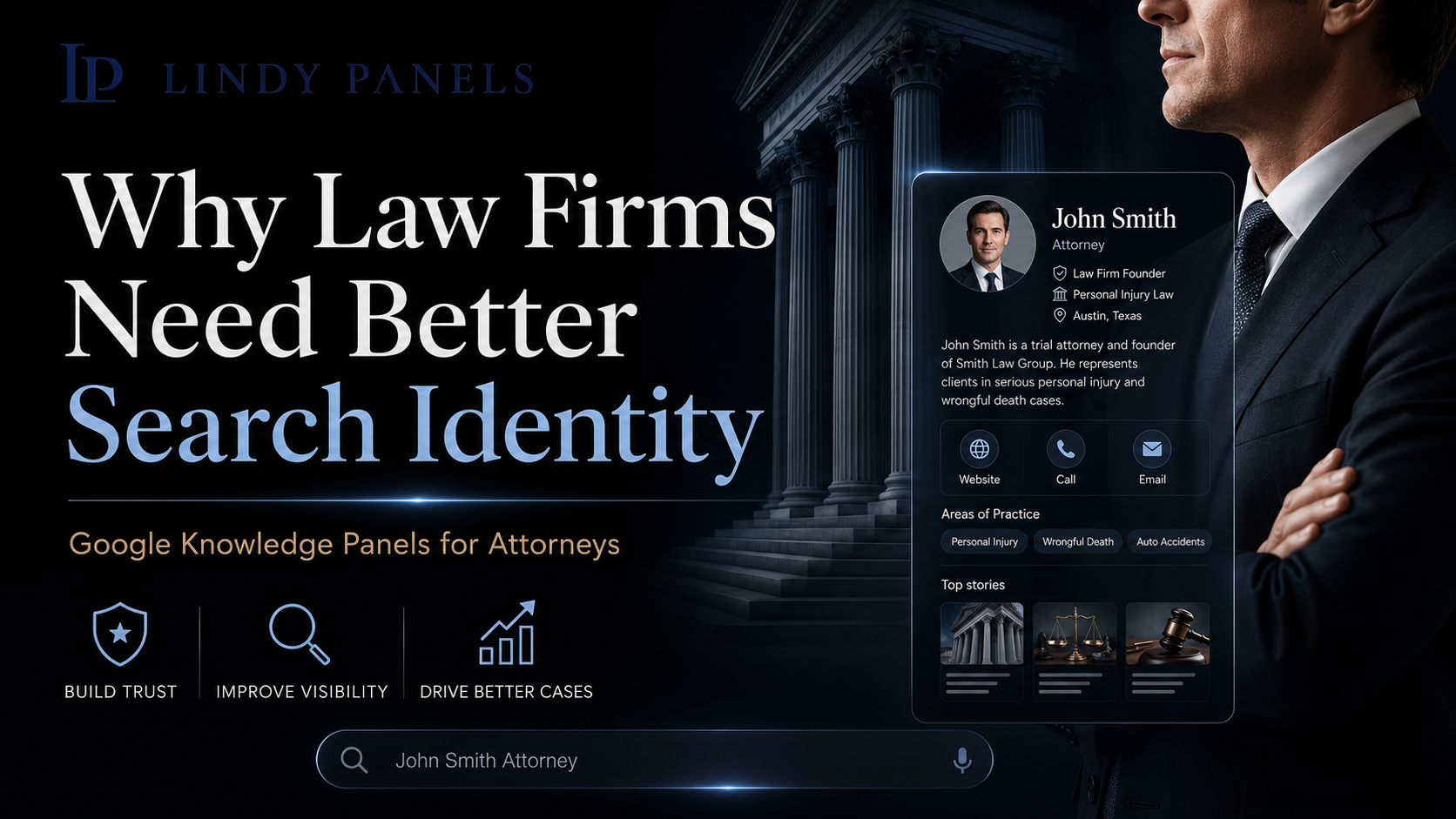

New legal-industry offering strengthens attorney recognition across Google Search and AI systems by supporting the conversion of expensive paid-search traffic
NEW YORK, NY, UNITED STATES, July 31, 2026 /EINPresswire.com/ — Lindy Panels, a digital identity company specializing in the creation and optimization of Google Knowledge Panels, today announced the expansion of its services for law firm founders, managing partners, and prominent attorneys whose individual reputations directly influence client acquisition, referrals, recruiting, and media visibility.
The expanded offering addresses a common weakness in legal marketing. Law firms may spend heavily on pay-per-click advertising, lead generation, public relations, legal directories, television, and content while the attorney expected to convert that demand remains poorly represented when searched by name.
A prospective client may first discover a firm through a paid advertisement. Before booking a consultation or signing an engagement letter, that prospect will often search the individual lawyer who appears in the advertisement, owns the firm, or is expected to handle the matter.
If that search produces disconnected directory listings, outdated biographies, ambiguous name matches, or little evidence connecting the lawyer to the firm and practice area being advertised, the firm can lose confidence after already paying to acquire the prospect.
“Law firms are buying some of the most expensive attention on the internet, but the transaction rarely ends with the click,” said Abhay Aditya Jain, founder and CEO of Lindy Panels. “The prospect searches the lawyer. If that lawyer does not appear as a recognizable, credentialed, and clearly understood entity, the firm has created a conversion problem inside a funnel it has already paid for.”
Lindy Panels’ expanded legal-industry service is intended to help search engines identify the attorney as a distinct person, connect the lawyer to the correct firm and professional history, and corroborate those relationships across sources the attorney does and does not control.
The company is initially focusing the expanded service on law firm founders and managing partners, along with attorneys working in reputation-sensitive practice areas such as securities law, private equity, real estate, white-collar defense, complex litigation, personal injury, entertainment law, corporate transactions, and high-net-worth private client representation.
Paid Traffic Often Becomes a Search for the Lawyer
Legal services remain among the most competitive categories in paid search. Firms may pay for clicks around urgent, high-value matters, then invest further in intake teams, call tracking, landing pages, remarketing, and consultation scheduling.
Those systems can create the opportunity, but they do not eliminate the prospect’s independent diligence.
A potential client evaluating a serious legal matter may search the lawyer’s full name, the lawyer and firm together, the attorney’s practice area, disciplinary history, major cases, media appearances, reviews, and professional affiliations.
The search is often an attempt to answer a simple question: Is this the person I should trust with this matter?
A polished advertisement can create interest. A coherent personal search result can help preserve it.
Lindy Panels does not claim that a Knowledge Panel alone guarantees a specific increase in conversion rates. Conversion depends on the practice area, offer, website, reviews, intake process, responsiveness, fee structure, and the client’s circumstances.
The company’s position is narrower: when a prospect searches an attorney and finds an incomplete or confusing identity, the firm introduces avoidable friction at a critical point in the decision process.
“For many firms, attorney search visibility should be treated as conversion infrastructure,” Jain said. “The firm has already paid to generate the search. The question is whether the second search reinforces the first impression or weakens it.”
Beyond Schema: How Search Systems Establish an Entity
The expansion also formalizes an entity-recognition methodology developed by Jain and applied across Lindy Panels engagements.
According to Jain, much of the public discussion around entity SEO overstates the role of schema markup. Structured data is useful because it gives search systems a machine-readable declaration of names, roles, organizations, and relationships.
However, markup published on a person’s own website remains a first-party assertion. It is not the same as independent corroboration.
“Schema can declare a relationship. It cannot independently prove it,” Jain said. “A law firm can mark up a founder as an attorney and managing partner, but Google still has to determine whether the wider public record supports that claim, whether the sources refer to the same person, and whether the relationships are consistent.”
Lindy Panels begins by making important relationships explicit in language.
A page that contains an attorney’s name and a practice area creates co-occurrence. A sentence stating that the attorney founded a particular firm, serves as its managing partner, and practices in a defined field expresses identifiable relationships.
In knowledge representation, those relationships can be understood in subject-predicate-object form:
The attorney founded the law firm.
The attorney serves as managing partner of the law firm.
The law firm operates in a defined area of legal practice.
The distinction matters because search systems are not merely counting how often words appear together. They attempt to extract facts, resolve entities, connect relationships, and evaluate whether multiple sources support the same interpretation.
Google Research has described knowledge-base construction systems that combine information extracted from text, tables, page structure, human annotations, and existing knowledge repositories, then use probabilistic methods to estimate the correctness of candidate facts.
Lindy Panels translates that technical principle into a practical campaign framework built around explicit relationships, source consensus, and disambiguation.
Consensus Is Stronger Than Self-Declaration
A relationship stated on one controlled website is a claim. When the same relationship is stated consistently across credible and sufficiently independent sources, the machine has more evidence that it represents the real world.
This does not mean repeating identical promotional copy across hundreds of low-value pages. It means ensuring that legitimate sources agree on foundational facts such as the attorney’s name, role, firm, professional description, location, and career history.
A lawyer described as a securities and private equity attorney on the firm website, a business consultant on one directory, an entrepreneur on another profile, and a real estate executive in an unrelated article may have substantial visibility but weak entity clarity.
“A high volume of inconsistent mentions can produce more noise, not more confidence,” Jain said. “A smaller body of credible sources describing the same person, attributes, and relationships coherently can create a much stronger factual pattern.”
For attorneys, Lindy Panels may evaluate and align the relationship between the lawyer and the firm, current and former positions, practice areas, bar and professional profiles, media commentary, authored articles, interviews, speaking appearances, awards, social accounts, professional images, and associated organizations.
The objective is not to make every page mechanically identical. It is to prevent basic facts from contradicting one another and to ensure that the attorney’s defining relationships are expressed clearly enough to be extracted and corroborated.
Disambiguation Is a Commercial Issue
The other major component is disambiguation.
A name is only a string until a system determines which real-world person it represents. Search engines use surrounding context and connected entities to distinguish people and organizations with the same or similar names.
For a lawyer, the relevant context may include the firm, geography, bar jurisdiction, practice area, education, professional associations, publications, clients or matters that may be discussed publicly, and other recognized people or organizations.
When those signals point toward different identities, Google may fail to resolve the lawyer confidently, merge information with another person, or leave the name as an unmatched collection of pages.
This is not merely a technical inconvenience. It can affect how quickly a prospective client, journalist, referral partner, recruit, or AI system understands who the attorney is.
“Ambiguity is not neutral in a high-trust transaction,” Jain said. “When someone is deciding whether to place a major case, investigation, transaction, or personal matter with a lawyer, uncertainty creates resistance. The attorney should not be confused with an unrelated person or presented as a collection of unconnected mentions.”
For a law firm investing heavily in paid acquisition, this ambiguity can become a measurable commercial weakness.
The firm may successfully persuade a prospective client to click an advertisement, visit a landing page, submit an inquiry, or schedule an initial consultation. However, the prospect’s subsequent search for the lawyer can reopen questions that the advertisement was intended to settle.
The attorney’s personal search presence therefore sits between demand generation and client conversion. Lindy Panels’ position is that firms should evaluate this layer with the same seriousness applied to landing-page design, intake speed, call handling, and online reviews.
The Lindy Panels Process for Attorneys
Each engagement begins with research into what Google and other search systems appear to have extracted, rather than relying only on what the firm intended to publish.
Depending on the attorney’s existing footprint, the work may include:
Establishing or improving a clear entity home for the attorney
Expressing important professional relationships explicitly in on-page language
Implementing appropriate Person, Organization, ProfilePage, and related structured data
Reconciling inconsistent names, titles, biographies, and firm affiliations
Strengthening corroboration across credible third-party sources
Connecting the attorney to the correct semantic and professional context
Improving image and profile consistency
Resolving confusion with similarly named people
Supporting the development and claiming of a Google Knowledge Panel
Monitoring the entity for changes, conflicts, and panel instability
Lindy Panels does not sell access to Google, control Google Search, or guarantee that a particular search feature will display indefinitely. Google generates Knowledge Panels automatically and controls their content and appearance.
The company also distinguishes Knowledge Panel work from local SEO and Google Business Profile management.
A Business Profile generally represents a firm or office location and may display reviews, hours, contact information, and map data. A personal Knowledge Panel reflects Google’s understanding of an attorney as a distinct entity.
Both can support a law firm’s broader search presence, but they perform different functions.
Supporting Recognition Across Search and AI
The expansion also reflects the growing use of AI-assisted systems to research lawyers, firms, professional histories, and areas of expertise.
Prospective clients and business partners can now ask direct questions about an attorney rather than manually reviewing each search result. AI-generated answers may be influenced by public websites, professional profiles, structured information, recognized publications, and other accessible sources.
No company can guarantee what an AI system will say about an attorney. However, when the underlying public record contains conflicting roles, names, descriptions, and organizational relationships, the system has less reliable material from which to produce an answer.
“LLMs face the same central problem as search engines: they need to determine which claims refer to the same person and which sources can be reconciled,” Jain said. “If the public record is confused about what an attorney does, where the attorney works, or which person a name refers to, the model may avoid making the connection altogether.”
Lindy Panels therefore treats Knowledge Panel development as part of a broader identity architecture spanning traditional search, the Google Knowledge Graph, and AI-driven discovery.
Building on Lindy Panels’ Existing Work
The legal-industry expansion builds on Lindy Panels’ broader work around executive identity, enterprise trust, and the way search systems interpret people and organizations.
Previous company coverage has argued that professional reputation is no longer determined only by whether someone is visible, but by whether search and AI systems understand that person correctly.
The new attorney offering applies that principle to a market where the personal reputation of the practitioner often drives the commercial performance of the firm.
Jain’s work focuses on Knowledge Panels, entity recognition, source alignment, identity disambiguation, and AI search visibility. At Lindy Panels, he oversees the company’s Knowledge Graph strategy and long-term panel management for founders, executives, investors, attorneys, public figures, and executive teams.
Lindy Panels has created more than 500 Knowledge Panels and monitored more than 200,000 panels across 35 industries. The company works with clients in the United States and internationally.
Availability
The expanded Google Knowledge Panel service for law firm founders and managing partners is now available in the United States and selected international markets.
Attorneys and law firms may request an initial strategy call through LindyPanels.com.
Lindy Panels is an independent company and is not affiliated with, endorsed by, sponsored by, or acting on behalf of Google LLC. Google controls its Search products, Knowledge Graph, Knowledge Panels, verification processes, and display decisions.
About Lindy Panels
Lindy Panels is a digital identity company specializing in the creation, development, correction, and optimization of Google Knowledge Panels for founders, chief executives, investors, attorneys, public figures, and other established professionals.
The company helps clients organize the public information that search engines and AI systems use to identify people and organizations. Its work can include entity research, source alignment, structured data, identity disambiguation, professional profile correction, Knowledge Graph development, Knowledge Panel claiming assistance, and continued monitoring.
Lindy Panels
Lindy Panels, Inc
+1 6465389968
email us here
Visit us on social media:
LinkedIn
Instagram
Facebook
YouTube
Legal Disclaimer:
EIN Presswire provides this news content “as is” without warranty of any kind. We do not accept any responsibility or liability
for the accuracy, content, images, videos, licenses, completeness, legality, or reliability of the information contained in this
article. If you have any complaints or copyright issues related to this article, kindly contact the author above.

Media gallery