Author Marvin Wilcher Warns AI Could Create Great Depression-Level Joblessness by 2030
Veteran entrepreneur projects more than one million U.S. humanoid robot workers by 2030 as companies move from hiring

Press Release Disclaimer: This is a press release distributed through the XPR Media network. It has not been independently verified by our newsroom.

Veteran entrepreneur projects more than one million U.S. humanoid robot workers by 2030 as companies move from hiring people to deploying machines to save money
OAKLAND, CA, UNITED STATES, July 27, 2026 /EINPresswire.com/ — More than one million humanoid robots could be working in the U.S. by 2030, replacing or compressing human labor across factories, warehouses, restaurants, hotels, hospitals, retail stores and logistics centers, according to an independently developed projection by veteran entrepreneur and business strategist Marvin Wilcher.
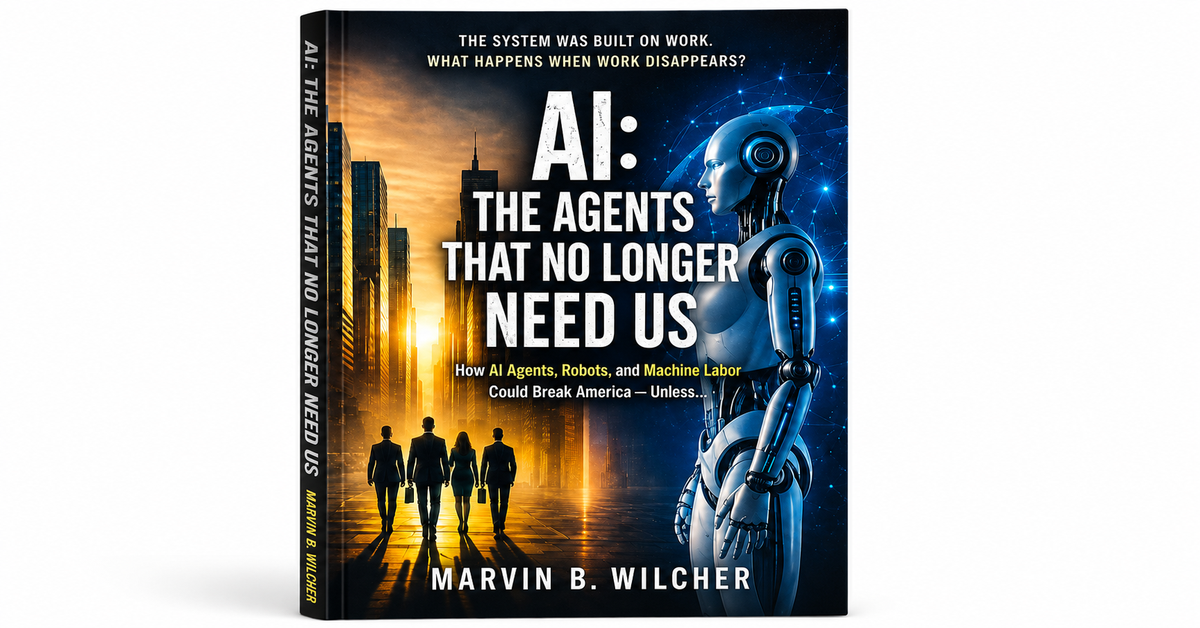
In his new book, AI: The Agents That No Longer Need Us, Wilcher argues that artificial intelligence and humanoid robotics could create Great Depression-level employment disruption even while companies, factories and the broader economy continue operating.
“The next economic crash will not begin because businesses stop producing. It will begin because the machines keep working while millions of human workers lose their jobs and stop receiving paychecks,” Wilcher said.
Wilcher has experienced multiple waves of technological disruption during more than 40 years in business. He led a major music-distribution company with more than $100 million in annual sales when Napster transformed the industry, and he operated a chain of video stores as Netflix reshaped home entertainment. He believes machine-managed intelligence represents a fundamentally different economic shift, unlike anything human beings have experienced before.
After 12 months of research and economic modeling, Wilcher developed a structural stress-test model projecting a 24.6% unemployment-equivalent burden by 2030. The independently developed scenario combines baseline unemployment, direct technology displacement and secondary job losses caused by reduced household spending. For comparison, U.S. unemployment was estimated at approximately 24.9% in 1933.
MORE THAN ONE MILLION HUMANOID WORKERS BY 2030
Wilcher projects that more than one million humanoid robots could be working in the U.S. by 2030, increasing to nearly five million by 2035 and 25 million by 2040. His model further projects that humanoid systems could eventually capture nearly 60% of repeatable physical labor across manufacturing, warehousing, hospitality, food service, cleaning, healthcare support, retail and logistics.
Humanoid robots combine artificial intelligence with bodies designed for human workplaces. They can move between workstations, use tools, lift materials, sort products, inspect components and perform multiple categories of physical work.
“The million-robot threshold will be created factory by factory, warehouse by warehouse and company by company,” Wilcher said. “By the time America recognizes that humanoids have become a national labor force, the replacement system will already be operating.”
Commercial Humanoid Deployment Begins
In January 2026, Boston Dynamics unveiled the commercial version of Atlas and said its scheduled 2026 deployments were committed to Hyundai Motor Group and Google DeepMind. Atlas is intended for material handling, assembly, machine tending and order fulfillment. Boston Dynamics says the robot can operate autonomously, lift up to 110 pounds and replace its own battery.
Hyundai plans to deploy Atlas at its Savannah, Georgia-area automotive operations beginning in 2028 and expand its use into component assembly by 2030. It is also preparing U.S. capacity to produce as many as 30,000 robots annually.
Boston Dynamics Atlas information: https://bostondynamics.com/blog/boston-dynamics-unveils-new-atlas-robot-to-revolutionize-industry/
Hyundai AI robotics strategy: https://www.hyundaimotorgroup.com/en/news/hyundai-motor-group-announces-ai-robotics-strategy–to-lead-human-centered-robotics-era-at-ces-2026
We May Be the Cause of Our Own Destruction
The transition may accelerate because consumers will not initially experience humanoid robots as a threat. We may welcome them as affordable, financeable household assistants that clean, cook, provide childcare or eldercare support, maintain lawns, handle routine repairs, run errands and make daily life easier. A $50,000 robot could eventually be financed much like a car FOR $600 to $750 per month, while advanced models might lease for $1,000 to $1,500 per month, comparable to a premium automobile payment. Yet a household spending $2,000 per month on childcare, $250 on lawn care and additional amounts on housekeeping, meal preparation, elder caregiving, deliveries and minor repairs could view that monthly robot payment as a bargain. As millions of families adopt these machines for convenience and savings, production will scale, prices will fall and their capabilities will improve. In seeking relief from rising household costs, we may unknowingly help build and finance the labor-replacement system that ultimately eliminates millions of jobs.
Production Continues While Paychecks Disappear
Wilcher’s central warning in the book is that a machine economy can continue producing even as human employment contracts. Robots may perform the work, but displaced workers no longer receive the wages needed to purchase what the automated economy produces.
“The robot does the work, but it does not become a consumer,” Wilcher said. “It does not buy groceries, pay rent, purchase a home or spend wages in the local economy. The company keeps the productivity, but the community loses the paycheck.”
Wilcher projects that widespread displacement could reduce consumer spending, business revenue, and federal, state and local income- and payroll-tax collections while increasing the number of households requiring public assistance.
The book introduces Wilcher’s proposed Labor Replacement Tax, built on two principles: “If machines take the work, machine value must carry the obligation,” and “The tax base must follow the work.” The proposal focuses on economically significant situations in which AI agents, autonomous systems and robots replace or compress paid human labor while producing measurable financial value.
Labor Replacement Tax information: https://laborreplacementtax.com/
About the Book
AI: The Agents That No Longer Need Us examines AI agents, humanoid robots, employment displacement, consumer purchasing power and the future of America’s labor-supported tax system. The book will be released July 28, 2026, in paperback for $19.99 and eBook for $9.99. Purchase information and book details are available at https://aidoesntneedus.com/.
About Marvin Wilcher
Marvin Wilcher is a veteran entrepreneur, author, business strategist and futurist with more than 45 years of business experience. He has acquired more than 27 companies and has operated across manufacturing, technology, retail, media, renewable energy, software and business consulting.
Media Contact
Marvin Wilcher
Really Knows Network
Email: marvin@reallyknowsnetwork.com
Telephone: 707-853-6585
Website: https://aidoesntneedus.com/
Marvin Wilcher
Really Knows Network
+1 707-853-6585
marvin@reallyknowsnetwork.com
Visit us on social media:
LinkedIn
Instagram
Facebook
YouTube
Legal Disclaimer:
EIN Presswire provides this news content “as is” without warranty of any kind. We do not accept any responsibility or liability
for the accuracy, content, images, videos, licenses, completeness, legality, or reliability of the information contained in this
article. If you have any complaints or copyright issues related to this article, kindly contact the author above.

Media gallery